Posts

Showing posts with the label Christmas

Savory cheese flan, with walnuts and pomegranate sauce

Image
      Have you ever wondered what ancient Greek cooking would taste like? If ancient Greeks could have known that people in the future would be interested in their cuisine, they would most certainly have written down everything about their art of cooking.  During what we now call the ‘classical period’ ancient Greek civilization reached its peak. Tragic plays and Aristophanes’ comedies describe daily life including scenes around a table. Deipnosophists (from deipnon - dinner and sofos - wise) writing about the philosophic discussions taking place in rich people’s houses during gastronomic feasts described the menus in great detail. These sources inform us that Athenians had three daily meals out of which ‘’deipnon’’, late in the evening, was the last and most rich meal of the day. Dinner in modern Greece is still called ‘’deipno’’.  Their diet consisted of a great variety of fish, meat from both game and stock farming, grains such as barley and wheat and, o...

Diples - crispy, festive bow ties with honey and walnuts

Image
Here in the Peloponnese, along with the all time classic melomacarona and kourampiedes cookies, we also make diples (δίπλες) for the Christmas and New Year season. Diples, a word which means ‘’folded’’ in Greek, are made of thin sheet-like dough rolled into long, thin strips, folded, then fried in hot oil, and dipped in syrup. Folding the dough in hot oil demands a little experience; but you can make diples in all sorts of simple shapes, - the most common are bow ties and free form geometric. Diples are served drizzled with honey, chopped walnuts and cinnamon. In Crete  the tradition is to make  dairy and egg free diples, mostly for weddings. These are  called xerotigana (ξεροτήγανα) and  are made with really long  thin zigzag strips of dough formed into spirals and of course served with honey and chopped walnuts . These last  two ingredients  symbolize  prosperity, fertility, and joy in Greek tradition.  Diples  Ingredients: 500gr ...

Kourabiedes (Κουραμπιέδες)

Image
 It will only take a moment of your time, it will not cost you anything, and you will be helping to ensure somebody somewhere gets a meal they desperately need. Thank you for your kind consideration. Now, on to the fun stuff- a sweet Greek recipe! One of the quintessential Greek holiday cookies is immediately recognizable by its confectionery sugar- dusted coat. Though they may be made in a variety of shapes, Kourabiedes (pronounced “koo-rah-bee-YEH-thess”) are most often fashioned into an S shape or lady finger style biscuit. My own preference is for a round bite-sized type of cookie, and that is how I make them. Kourabiedes are butter cookies traditionally baked for Christmas and Easter festivities, but they keep well when stored, so you can enjoy them with a morning Greek coffee long after both holidays have passed. In some regions of Greece, the Christmas Kourabiedes are adorned with a single whole spice clove embedded in each biscuit. This is done to commemorate the spi...

Christopsomo – Christmas Bread (Χριστόψωμο)

Image
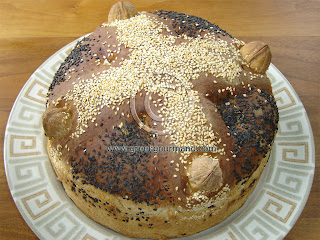
My Greek Christmas bread in all its glory. Click to Enlarge Image. The many centuries-old custom of the Christopsomo or ‘Bread of Christ’ is a universal Christmas Greek food tradition. Today, all over Greece and throughout the Diaspora, Christopsomo loaves will be baked and set aside for the breaking, which depending on where you are from in Greece is performed at either Christmas Eve dinner or lunch on Christmas Day. This bread is a sweet yeast bread, and is characteristically decorated with the symbol of the cross which is usually embossed overtop of the loaf with two dough strands that intersect and divide the bread into four segments. Other standard decorations include walnuts in their shells and sesame seeds (white and black). More elaborate designs are also traced on the surface of the loaf in some regions of Greece, as in Crete, where ornate symbols are carved into the surface of the bread. Usually these symbols are associated with the livelihood of the family. For instance, ...