Posts

Showing posts with the label Sweet

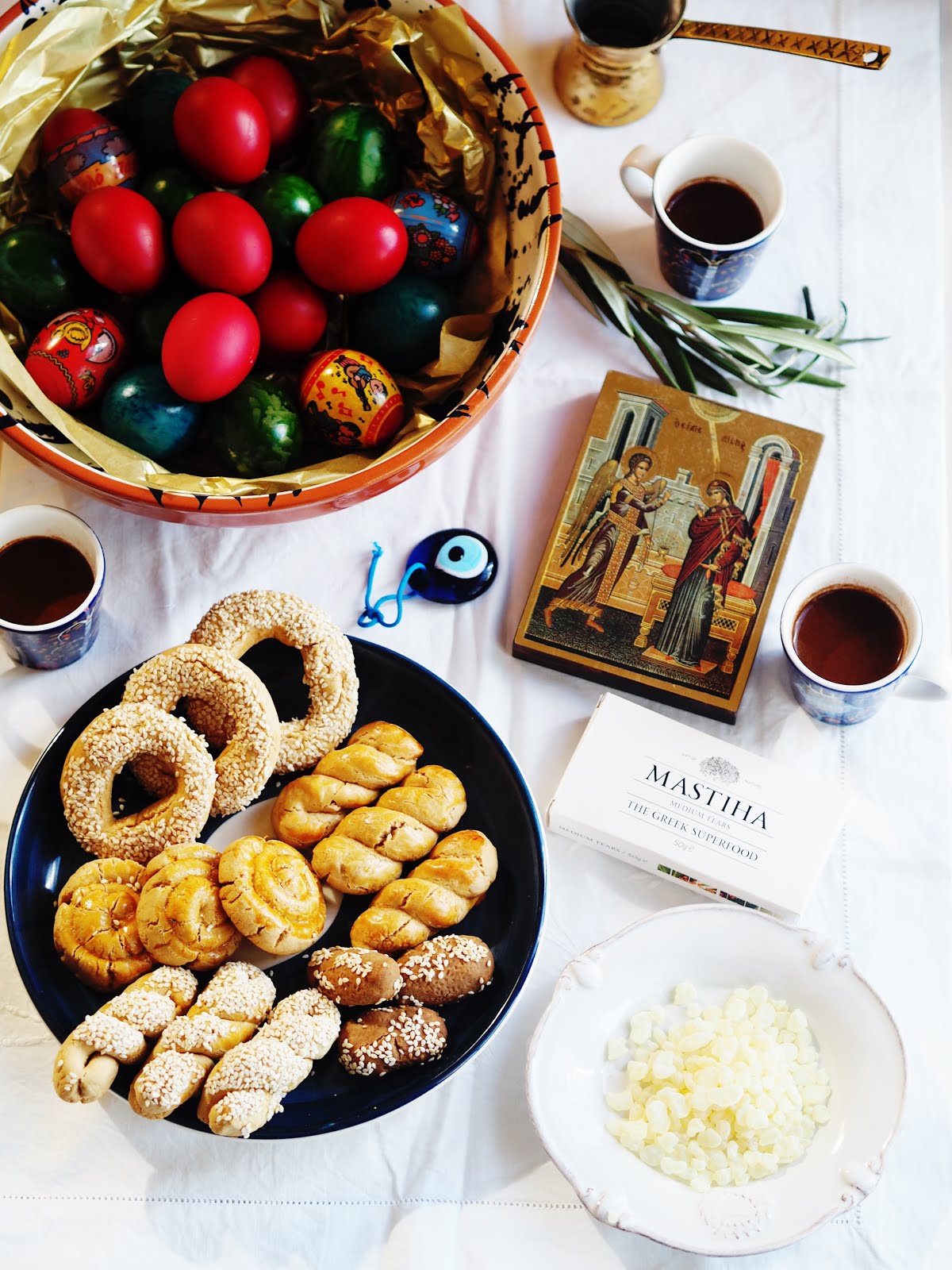
Gluten free Koulourakia with mastiha (Kουλουρακια με μαστιχα - χωρις γλουτενη)
Image
Easter remains the most important celebration for my Greek family. I love the traditions of colourful dyed eggs, tsoureki and  the Easter biscuits - Koulourakia. Holy Thursday has always marked the start of Easter preparations in our house, the day the eggs are dyed red and the  Koulourakia are made. For those in our family who are not friends with gluten, it seemed a shamed for them to miss out on part of the Easter traditions. So, this year, I have tried my hand at making some gluten free Koulourakia, flavoured with plenty of lemon, vanilla and the most incredible Greek superfood - Matsiha.    Mastiha are like little dusty pieces of crystal - which come from mastic-tree resin and are only found on the Greek island of Chios (I long to visit Chios one day - hopefully soon!).  Mastiha has been harvested on Chios for at least 2,500 years since Greek Antiquity. Mastiha is reported to have plenty of health benefits from  digestive issues to skin regeneration. I...

Pine honey, almond and pine nut tart (Ταρτα με πευκομελο, αμυγδαλο και κουκουναρι)

Image
One of my favourite Greek products, is the dark pine or ‘honeydew’ honey from the forests of Peloponnese. It has a malty, spicy aroma and a caramelized flavor.   It is the perfect honey for using in this simple tart, as a floral honey could easily overwhelm the buttery shortbread-like crust and mild pine nuts. Pine honey also has fewer calories and a lower total sugar content than floral honeys and is rich in minerals and amino acids.    You could make your own short crust pastry base for this tart, but I like to use the wonderfully light and crumbly Careme gluten free short crust pastry. It has a subtle nutty flavour from wholegrain flours , which works so well with the almonds and pine nuts in this tart. This is a great cupboard standby dessert, which couldn’t be simpler to make. It is best served with a dollop of thick, Greek style sheep milk’s yoghurt for a luxurious touch. Pine honey, almond and pine nut tart (Τάρτα με πευκόμελο, αμύγδαλο και κουκουνάρι) Se...

Fanouropita (φανουροπιτα)

Image
A 'Fanouropita' (φανουροπιτα) is a cake that is traditionally made in Greece to honour Saint Fanourios, patron saint of lost things, on August 27th. The Saint's capacity to help find something lost is suggested in his name, in the Greek language, φανερώνω (fanerono) means reveal. In seeking the intercession of the Saint, for something lost, the Greek people will take their baked caked to the village church to be blessed. Then it is shared among the congregation. As such, whoever made the cake is supposed to be given hope that whatever they have lost may be found.  The cake itself is vegan and flavoured with olive oil, cinnamon, cloves and orange. It a sort of Greek version of gingerbread (albeit, without the ginger). Tradition requires the cake to be made with 7 or 9 ingredients and it must contain  fruit and nuts, so that you are able to "find" something while you eat the cake.  Fanouropita (Φανουρόπιτα) 4 cups self raising flour 1 & 1/2 teaspoons of ground...

Kumquat and metaxa marmalade (κουμ κουατ και Μεταξα μαρμελαδα)

Image
The best thing about returning home from a Greek summer? It has to be spending time with family and friends that we missed while we were away and drinking in the winter sunshine in dad's beautiful garden.  While we had been basking in the Greek summer sun, dad's citrus was revelling in near perfect growing conditions in a little corner of inner west Sydney. Dad's citrus was not alone, with many Australian farmers reporting it had been an amazing year for all kinds of citrus fruits.  The kumquat tree in dad's garden was quiet simply heaving with little orange gems. Talk about a Christmas in July! The kumquat tree came with the best kind of Christmas decorations - edible fruit. Well, 'edible' fruit that requires a little tender loving care. You certainly would not want to be eating these juicy but bitter little guys fresh straight from the tree.  That is where Ma's sage advice came to the fore. The kumquat is such an Ionian kind of fruit.  Commonly made into a...

Figs roasted with bay, spices and petimezi (Σuκα ψητo με δαφνης, μπαχαρικα και πετιμεζι)

Image
One of nature's greatest gifts has to be figs. A nutrition packed sweet treat, that plays such an important part in Greek and Mediterranean diets. For the few short weeks at the end of summer and the beginning of autumn, I love to enjoy figs fresh from the tree - or when they run out, from our local farmer's market. The closer we get to winter though, the less perfect figs become. However, that said, oven-roasting figs will bring out the flavour of less-than-perfect, end of season figs. In Greek cooking traditions, figs are often pared with spices - particularly when they are dried. In Corfu, black pepper is the spice of choice. In the other Ionian islands and the Peloponnese, bay leaves are often used to scent and help preserve the dried figs. On the island of Ikaria, dried figs are sprinkled with antioxidant-rich oregano when stored. In Chios, the spice of choice is of course mastiha and in other Aegean islands the choice of spice is often cinnamon. In Crete, another regional...

Cooking with Tselementes: rizogalo (ριζoγαλο)

Image
It would be safe to say that Rice Pudding is an ultimate comfort food around the globe. Nearly every culture has their own variations on this luscious, nursery-food style treat. In Mr K's family home, when treats were on offer - they often came in the form of Greek rice pudding, called rizogalo (ριζόγαλο). Rizogalo is a creamy, mouth-filling delight of sweetened rice, full cream milk and the subtle flavourings of cinnamon and lemon. When served warm, it is rich and comforting - like a big sweet hug in a bowl. Perfect in Autumn when the weather starts to become a little cooler. But when the weather is warmer, rizogalo is equally good served cold. Despite it's carby underpinnings, served cool rizogalo is surprisingly refreshing, especially when dusted with an extra large dose of cinnamon. A few weeks ago, I posted a recipe from the holy grail of Greek cooking, Tselementes. In that I post, (which you can under the "Tselementes" tag on the recipe index page opposite right...

Citrusy Ionian Style New Year Cake - Vasilopita (Βασιλoπιτα)

Image
As 2015 comes to a close,  I am so thankful to all who have taken an interest in this little blog over the last year. It is so wonderful to be able to share something I love to do with you and I wanted to say thank you to those reading in Australia, Greece, Cyprus and all over the world. What better way is there to say thank you than by offering up some baking goodness?  In Greek homes, when the New Year arrives, it is also the feast day of St Basil (Aghios Vassilios) and it is traditional to celebrate the day with a "vasilopita" - a bread or cake which has a foil wrapped coin hidden inside. In this post, I am sharing with you the cake version - inspired by the flavours of the Ionian islands, with plenty of citrus and a little splash of brandy.  On New Years day, the family gathers around the table and the head of the household will make a sign of the cross over the bread or cake and turn it three times - once for the Virgin Mary, once for Christ and once for the house. A...

Aunty Sophia's Zakynthian revani (Ρεβανί)

Image
"That's it" said Mr K, "I am in Theia Sophia's kitchen" he said taking a bite of a piece of revani and reaching for another. Readers of this blog will know that my husband's favourite cake is revani - or as he calls it, semolina cake. Ever since I found out this little piece of information, I have been on a search to make a wonderful revani that lives up to his childhood memories. It had been difficult to track down a good recipe - my mother in law and my husbands other aunts (who live in the same street) did not make revani. As Mr K recalled, Theia Katina always makes the most wonderful melamokarona and pumpkin pita - and revani cake is Theia Sophia's speciality. Mr K recalled his aunt bringing big trays of revani down the street to his home for family celebrations and sometimes, just because. This was before his Aunt Sophia and her family moved back to Greece. For Mr K revani is the food of happy memories and good family times. I had made revani a ...

Chocolate olive oil fudge cake (κέικ σοκολάτας ελαιόλαδο)

Image
It is no secret how much olive oil is loved in our house - we even travelled to Greece and Italy a few years ago and timed the trip with the new oil harvest (you can read more about that trip here ). That love of olive oil extends to this chocolate fudge cake recipe, where I have used it in place of butter. The robust flavour of the olive oil enhances the bitter, chocolatey flavour that comes from Dutch-process cocoa.   Olive oil is a great baking alternative for those who can’t eat (or prefer not to eat) butter — in this cake I have used Greek extra-virgin olive oil, it has a robust, slightly peppery flavour and it really matches well with the bitterness of the dark cocoa. The quality of the olive oil is the key to this recipe, as the flavour of the oil really does subtly permeate the cake.   While the olive oil impacts on the flavour of the cake, it also has a big impact on the texture. Using oil instead of butter in the cake creates a very moist cake, with a fine crumb, whi...

Roasted strawberry and Greek basil 'NOY NOY' ice cream (παγωτό φράουλα)

Image
Each week my local market has a stall filled with beautiful berries and I always have to stop and buy a small box or two, sometimes raspberries or most often, plump blueberries. As I reached for some absolutely giant jubilee blueberries, the stall holder also presented me with a huge container of the most beautiful fresh strawberries. They were not the giant, overgrown variety often sold in supermarkets, but little ruby red, absolutely gorgeous gems. Even though they were rather tiny and a little uneven in size, they had the most divine pure strawberry aroma. When I saw the container of strawberries at the market I knew instantly that they had to be used for an ice cream. The colour was so beautiful and they were just calling out to be mixed with cream. To make the strawberry flavour even more intense, I roasted the strawberries with a touch of raspberry vinegar and a little Greek basil. I really wanted to add the beautiful berries themselves to the ice cream for some texture, so roast...

Apple picking & Greek Apple Pie - Milopita (μηλόπιτα)

Image
Sometimes what I need more than anything is a little time away in the country - even if that means actually only just a short 40 minute drive away home. And that is how I came to find myself, with Mr K and the Zen's, at Glenbernie Orchard at Darkes Forest on a bright crisp autumn day, picking apples. The Apple Shack of Glenbernie Orchard is a 4th generation family owned farm where you can purchase fresh fruits, juice, cider, honey and preserves - if you visit in the right season you can also pick your own apples, persimmons and raspberries. The season for apple picking runs from from about November to April, so we made it right at the end of the 'pick your own' season. The apples on the trees were incredibly beautiful and of spectacular quality - the pink lady apples tasted fresh, tangy and sweet. With a few kilos of fresh apples in my kitchen, I decided to make a milopita (Μηλόπιτα) or Greek apple pie for Mother's Day - which is this coming Sunday in Australia. Milopi...