Posts

Showing posts with the label ancient

Mastic - Mastiha (Μαστίχα)

Image
From time to time, I like to mix a reflection or two in among my Greek food recipes. Today’s topic is one that really tickles my fancy. As far as spices go, there is surely none more unique or rarer than the mastic resin from the Greek island of Chios, reputed birthplace of the poet Homer. Pure mastic resin "tears" - Click to Enlarge Image. Mastic (or ‘masticha’ as we say in Greek, pronounced “mahs-TEE-ha”) is a resin produced by an evergreen shrub, Pistacia lentiscus , which is related to the pistachio tree. The word 'mastic' is derived from the ancient Greek verb ‘ mastikhein ’ which means “to chew”. The English word “masticate” (to chew) is derived from this root as well. While the mastic shrub, also known as skhinos in Greek or lentisk in English, does grow elsewhere in the Mediterranean region, the mastic spice resin is only produced in the plots of the Mastic-Villages or Mastichochoria (Μαστιχοχώρια) in the southern end of Chios. It is believed that u...
Pan-fried Kalamari (Καλαμάρια Τηγανιτά)

Image
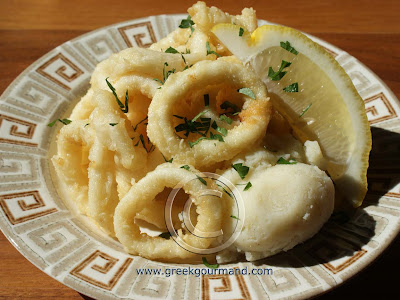
Those of you who have travelled to Greece or eaten at a Greek taverna will undoubtedly be familiar with this squid (kalamari) dish. Without question, this is one of the most recognizable Greek seafood dishes, and it is easily the simplest to prepare. My pan-fried kalamari served with scorthalia & a lemon wedge - Click to Enlarge Image Among ancient Greek foodies, squid was classified as “fish for the frying pan” and it was usually served up as a “forerunner” or appetizer to a meal. Over two thousand years later and not much has changed. Today, there is hardly a Greek food restaurant anywhere which does not include this dish on its menu. Usually, pan-fried kalamari is served with an accompanying dollop of tzatziki (garlic yogurt) sauce and a wedge of lemon. Instead of tzatziki, I often serve scorthalia (a garlic potato purée) along with these fried squid segments. This substitution is really quite a successful one and I highly recommend it. For anyone observing the Lenten fast...

Pasteli (Παστέλι)

Image
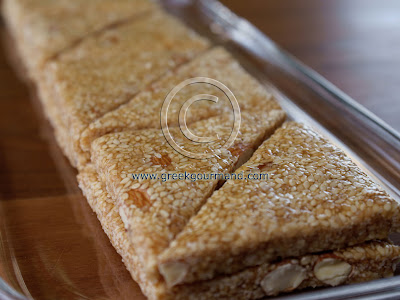
Ever wondered what sorts of foods the ancient Greeks ate? Here is a recipe for a healthful chewy snack that has satisfied and pleased children and adults alike for millennia. My Pasteli triangles - Click to Enlarge Image. Pasteli , the mere mention of the word will bring a smile to any Greek’s face. An all natural confection, in its simplest form, pasteli is composed of two ingredients: sesame seeds and honey. The addition of nuts such as walnuts, pistachios, or almonds is also common in some versions of pasteli . Sesame has been an ingredient in the Greek pantry since time immemorial. Mention of it is made in Linear B tablets found at Mycenae dated to the 14th Century BC. Indeed, the English word “sesame” is itself derived from the Greek word σησαμη or sēsámē. This combination of honey and sesame seeds to form wafers of chewy wholesome goodness is one Greek food concoction that has been around - quite literally - for ages. In the Archaic age and later in the Classical and H...

Tiganites: Greek Pancakes (Τηγανίτες)

Image
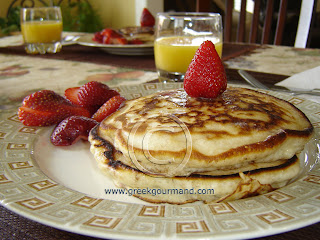
Aunt Jemima or Uncle Socrates? Click to Enlarge Image. What did the ancient Greeks eat? This question has been asked for centuries and it has spawned numerous scholarly, specialist, and dilettante studies on the matter. There have also been countless attempts at re-creating ancient Greek recipes and the Internet is full of such investigations. However, we need not look too hard to discover one ancient Greek food which is still around today; indeed it is a staple of numerous modern European and North American cuisines. In Canada and the United States we know them as pancakes or flapjacks , in France they are called crêpes , and the Scots and Irish know them as drop-scones or griddlecakes ; in Australia and New Zealand they are referred to as pikelets , and in Russia they are blini . The Greeks call them tiganites (Gk. τηγανίτες , pronounced as “tee-gha-NEE-tehs”) which is from the ancient Greek taginites ( ταγηνίτης ) and they have been a popular breakfast food in Greece sinc...

Loukoumades, The Ancient Olympic Treat (Λουκουμάδες)

Image
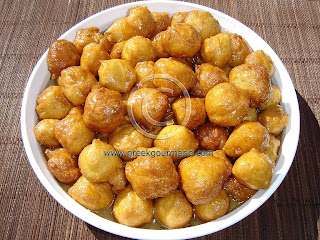
The official ancient Olympic doughnut - Click to Enlarge Image The Olympic Hymn Ancient immortal spirit, pure father Of the beautiful, the great and the true, Descend, appear, and emblaze this place With the glory of your own earth and sky. In the race, the grappling, and the toss, Kindle the impulse in all noble contests, Crown with the perennial wreath, And fashion the steely and worthy body. Plains, mountains, and seas glow in your presence Like some great clear porphyrous shrine, And every nation hurries here to your temple In supplication, ancient immortal spirit. - Costis Palamas (1859-1942) Translation from Greek by: S. Sotiropoulos, Canada ©2001 Two thousand seven hundred and eighty four years ago, in 776 B.C., the ancient Olympic Games were born. The very first Games were a simple affair consisting of only one event: a 200 metre footrace known as the ‘ s tadion ’ from which we get the English word ‘stadium’. Over time, th...

The Apple in My Pie (Milopita - Μηλόπιτα)

Image
My Milopita fresh from the oven - Click Image to Enlarge Apples are among the earliest fruits known to Europeans. The ancient Greeks have left us numerous references to the apple both in literary and philosophical sources. According to a couple of accounts, it was the god Dionysus who first introduced the apple to mortals. The apples from a town called Sidus, near the ancient city of Corinth were among the most prized of antiquity. Today, Greek apple farming takes place largely in central and northern Greece, especially around the village of Zagora on the slopes of Mt. Pelion, and in the vicinity of the city of Kastoria in Macedonia. Some apple farming also takes place near Tripolis, a city in the central part of the Peloponnese. The apples of all three areas are registered as Protected Designation of Origin (PDO) / Protected Geographical Indication (PGI) products of Greece by the European Union. “Apples Kastoria” (Μήλο Καστοριάς) are especially prized for their flavour. Greece produ...

Rizogalo (Ρυζόγαλο) - Greek Rice Pudding

Image
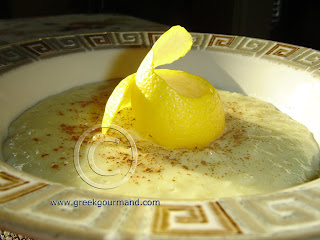
Rizogalo... my Greek rice pudding recipe in all its glory Rice has been known and consumed in Greece since ancient times. The first mention I could find in the historiography is a reference to one of Sophocles ’ lost (to us) plays. The Poet is quoted as mentioning a type of bread made with rice called « ορύνδου » (O-REEND-thoo). The noun « ορύζης » (O-REE-zis) in ancient Greek is the root of our modern English word “rice” ( Oryza sativa … not to be confused with other types of sativa... ;-). Then, as now, rice was mostly imported to Greece from climes that were better suited to the intensive wet-paddy agricultural environment required for its cultivation. For the ancients, rice was considered a rare luxury and it fetched a handsome price in the markets when it was available. It was not until Alexander the Great’s conquest of the East that rice became a relatively more common element in Greek gastronomy. Thus, although both the ancient Greeks and later the Romans were familia...

23 Almonds a Day Keep the Doctors Away - Bianketa

Image
Biankéta ... Almond Tangerine Bites. Puréed blanched almonds flavoured with tangerine rind and juice, sweetened with brown sugar and dusted with confectionery sugar before serving. These wonderful little delights leave a lingering tangerine flavoured scent in your mouth long after you eat them up! Cute little morsels... The almond (' amygdalo ' in Greek, pronounced "AH-MEEG-THA-LOW") has a long history in Greece. Today, Greece is the fourth largest producer of almonds in the world after the United States, Spain and Italy. The epicentres of Greek almond production are the prefectures of Magnesia, Larisa, Serres and Kavala, and the cultivation of the almond tree is a traditional practice that dates back to ancient times. In the Classical period, almonds were common "dinner ornaments" ( αναθήματα δαιτός ) and those from the island of Naxos were especially prized. Other centres of almond production in the ancient Greek world included Cyprus, Thasos, Paphlagonia...