Posts

Showing posts with the label Vegeterian

Homemade yogurt and poached quince

Image
     In Greece there are three different types of yogurt, depending on the milk (goat, sheep or cow) used to make it.       Yogurt made from cows’ milk is the most popular because of its mildness; it has a less sour taste compared with yogurt made from the milk of goats or sheep.      In Greece we call yogurt ‘’strained ‘’ if it has undergone a straining process after it has been created. As a result it has far less whey than plain yogurt. Its dense silky texture makes it ideal for cooking too.       If you are lucky enough to have access to fresh milk from local farms, you should definitely try at some point to make yogurt at home and experience its wonderful taste. If you have kids, they will be fascinated by the process that magically turns milk into yogurt.      We make yogurt at home when we have extra milk that is close to its expiry date; this way we give it at least an extra week of shelf life. ...
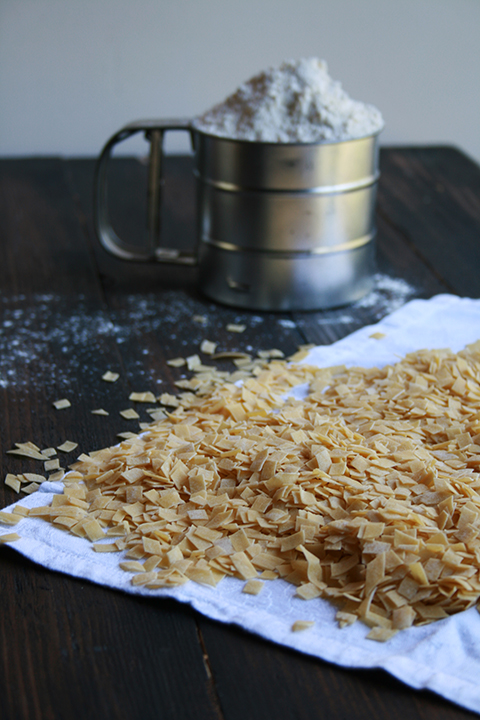

Hilopites: making fresh or dry pasta for winter soups and stews

Image
     I can’t recall any summer of my life that we didn’t make dry pasta at home for the winter. What has changed through the years is my role in this family tradition. When I was little and we spent the whole summer at our cottage, my mother, together with the other housewives in our neighborhood, would organize a ‘’hilopites week’’. During this week they would gather at a different house each day and help each other with the hard work of making enough of this pasta for the rest of the year. More hands can make the process easier, faster and actually fun, with lots of laughter, cakes, coffee breaks and gossip. I and the other kids were given a piece of dough to use as a ‘’play dough’’ so as not bother the mums who were working with their rolling pins and knives.       Nowadays we make even more pasta for the tavern, and not just in summer but during winter as well. Rolling pins have been replaced with pasta machines and my adult role calls for fast han...

Zucchini flowers, stuffed with rice, summer veggies, and herbs

Image
          Searching the Internet for some info on edible flowers, I saw some beautiful pictures of cakes and other fancy desserts decorated with, among other exotica, small blue and yellow pansies and chrysanthemum flowers. Did we always eat pansies on our cakes and in colorful salads or is it one more innovation from Noma (with its inventive kitchen) that has been immediately adopted by all of us?        Well, in fact, dried flowers have been used for thousands of years as spices in cooking or in herbal teas for medicinal purposes. Their use in modern cooking today as decorative edible ingredients is really a rebirth of this very old tradition.  Roses and zucchini- squash flowers have never stopped being used in cooking.       In Greece we make rose petal jam and we use zucchini flowers in different savory recipes.  When I was a child, whenever my mother made stuffed tomatoes, there would always be some sp...

Raw artichokes salad with bulgur, spring herbs and feta

Image
In Greek mythology, Cynara was a beautiful nymph who, having declined to live on Olympus with Zeus, was thrown to earth by the angry god and transformed into the tasty artichoke plant that we all love. His loss! The Peloponnese and Crete are the main regions where artichokes are commercially cultivated because they hate frost and need a mild climate in order to survive. In our garden we grow some wild thorny artichoke plants with a superb taste, but the common varieties found in most markets are bigger, lack thorns, and have a milder flavor that is still very tasty. In our area, fresh artichokes are served raw with lemon juice and extra virgin olive oil as a meze for ouzo or wine. Really fresh artichokes, have a crunchy, slightly nutty flavor that resembles the taste of raw chestnuts. I wanted to try them as a salad main course, so I used spring herbs for extra flavor, bulgur wheat to give bulk, and feta for some more protein and taste. The result was an aromatic flavorful dish which c...

Greek yogurt macaron, with a honey core

Image
I often wonder what could be characterized as a typical Greek flavor in pastry; and I usually come to the conclusion that yogurt and honey make a pair that many could consider as a classically Greek. So if I make a panna cotta with Greek yogurt and honey, would people think that this Italian dessert has a Greek twist? I can’t judge but it definitely tasted good. Since I have started this ‘alchemy’ of turning famous desserts into Greek with the addition of yogurt and honey, I have discovered that French macarons lend themselves to the treatment! The first time I ever saw macaron was five or six years ago when I started reading food blogs and came across the blog Tartelette . I remember how beautiful they looked in the pictures. Then I tried them in a pastry shop in Athens and was sure I should try making them myself. My research on the internet showed that macarons are more or less the ‘’Holy Grail’’ of every avid food blogger and I decided I needed one more cooking book, this time one ...

Tahini, coffee, and pistachios: vegan cake

Image
In Greece during the Great Lent when dairy products, meat, and eggs are not   consumed (at least for those who still keep these traditions), tahini based recipes enrich their diet with nutritious elements. Tahini, a paste made from ground hulled sesame seeds, is a super food and, added in soups and other vegetable or legume based dishes, it plays a vital role in good nutrition. It contains many vitamins and minerals and is also rich in protein, - 25 percent by weight!   In this blog you may have noticed that several recipes, sweet or savory have the ending pita in their name. That is because we tend to call pita any batter which is baked in a flat baking pan.   So today’s special is Tahinópita , a dairy and egg free cake with tahini as a basic ingredient. Although the original recipe calls for cinnamon and cloves, I decided we had enough cinnamon this winter so a small twist in this cake’s makeup was inevitable: coffee and orange zest in this case. They match really wel...

Sweet raisin buns flavored with cinnamon.

Image
Raisin buns (σταφιδόψωμα) , are for the Greeks what croissants are for the French: a sweet doughy breakfast delicacy. Every morning you can find them on sale inlocal bakeries next to bread rings and cakes.  Raisins and sultanas are great sources of energy for the human body, exactly what you need with a cup of tea or coffee to start your day. For many centuries the small dark currants and the larger blond sultanas have been an essential part of the agricultural economy of the Peloponnese. At the end of the 19th century and the first half of the 20th century, in particular, the English would import raisins in exchange for salted cod from the North Sea. As a result of this exchange,salted cod became, and still is,a special favorite at Peloponnesian tables.  When baking bread for the family, my grandmother would often save a piece of her sour dough to make a small loaf of raisin bread, or feta bread. The contradiction of the slightly sour taste of the bread with the sweetness of ...

Black eyed peas stewed with greens

Image
This post was especially written for Pretty Greek Villas , a site owned by my friends Marie- Louise and Ben. If you are thinking Greece this summer, take a look,for some of the most beautiful villas in the country. Peloponnesian cuisine is influenced by its sea-girt mountainous topography. Olive oil, wine, grains, pulses, herbs, wild greens, fish, goat and sheep meat, cheese and honey have been staples in local pantries for millenia.  Though olive trees do not flourish at its highest altitudes, still one third of the country’s entire production comes from here because of the quality of the soil and the mild climate. In fact, Peloponnesian cuisine could be described as an olive oil cuisine since generous amounts of olive oil (often added towards the end of cooking) are poured over greens, beans, and all sorts of stews.  The Northern Peloponnese cuisine has also been influenced by migrations over its long history and so it comprises elements of both the mainland and the islands,...

Savory cheese flan, with walnuts and pomegranate sauce

Image
      Have you ever wondered what ancient Greek cooking would taste like? If ancient Greeks could have known that people in the future would be interested in their cuisine, they would most certainly have written down everything about their art of cooking.  During what we now call the ‘classical period’ ancient Greek civilization reached its peak. Tragic plays and Aristophanes’ comedies describe daily life including scenes around a table. Deipnosophists (from deipnon - dinner and sofos - wise) writing about the philosophic discussions taking place in rich people’s houses during gastronomic feasts described the menus in great detail. These sources inform us that Athenians had three daily meals out of which ‘’deipnon’’, late in the evening, was the last and most rich meal of the day. Dinner in modern Greece is still called ‘’deipno’’.  Their diet consisted of a great variety of fish, meat from both game and stock farming, grains such as barley and wheat and, o...