Posts

Showing posts with the label vegetarian

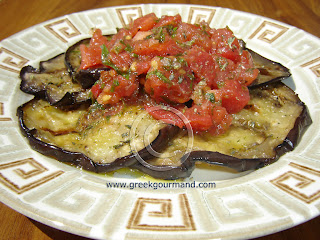
Eggplants smothered in garlic (Μελιτζανες σκορδοστουμπι οπως στο Τζαντε)
Image
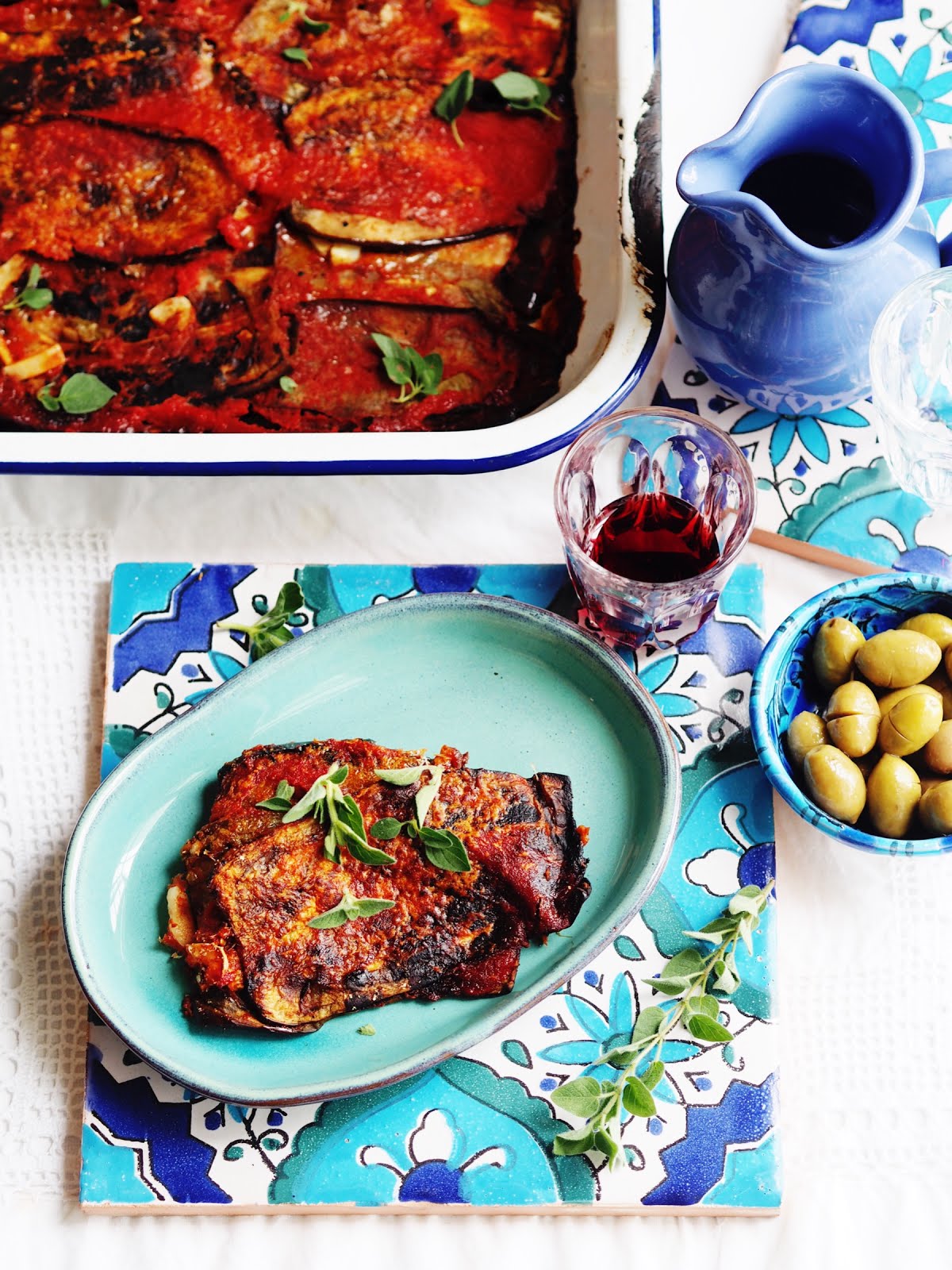
Give a Greek person a vegetable, any vegetable, and they will transform it into a mouthwatering feast. Summer vegetables, especially succulent tomatoes hardly require any exhaustive transformation because they are just so delicious - all you need is a little oil and vinegar. However, in this traditional Zakynthian dish, summer tomatoes combine with the humble eggplant and a lot of garlic to make a truly spectacular dish. If you were in Napoli, the garlic in this dish would be replaced with oozy mozzarella cheese and dustings of parmigiano reggiano. In Greek cuisine, there are strict (albeit unsaid) rules when it comes to using cheese. Hard cheeses are for eating at the table, with along with a generous bowl of olives. Soft cheeses, like feta, are crumbled into pies or a large slices adorn salads. Rarely are cheeses used in vegetable dishes - perhaps this comes from the tradition of fasting in the Greek orthodox church. In the long fasting months leading up to Ch...

Watermelon, feta and chilli salad ( Σαλατα με καρπουζι, φετα και πιπερια τσιλι)

Image
I can't imagine summer without chilled watermelon, its fresh cool juice and crunchy edges. During our summer in Greece last year, every market we visited from Athens to Naxos had stalls selling huge watermelons, all piled up into pyramids or towers. Driving in the country side, there were trucks pulled over on the side of the road selling the hot pink and green fruits - the infamous summer kapouzi was inescapable!  When the weather is so hot that you can't even face cooking, this salad is perfect. The watermelon is tossed together with salty Greek sheep milk feta cheese, mint and Thai basil leaves, sweet red onions and a little hit of chilli. It's best served really chilled, so you can prepare the salad and leave it in the fridge - just add the herbs and pour over the olive oil and toss before serving. It's just like a Greek summer on a plate!  Watermelon, feta and chilli salad ( Σαλάτα με καρπούζι, φέτα και πιπεριά τσίλι) Serves 4; preparation time 15 mins  Ingredients...

Greek Cucumber Salad - Αγγουροσαλάτα

Image
With the summer in full swing here in the northern hemisphere, many of us are seeking relief from stifling temperatures. In some regions new record seasonal highs have been recorded; here in Toronto the past week was a true scorcher. Fortunately, Greek food culture includes recipes that are perfectly suited to beating the heat. A bird's eye view of my Greek cucumber salad, click to enlarge When Greeks sit down to a summertime meal, they will invariably include a raw salad of one kind or another. One of the more popular summertime Greek salads in our family is the world famous Aggourosalata (ah-goo-roh-sah-LAH-ta), or, Cucumber Salad. There are a few variations on the theme, but it is a very basic dish and serves as a refreshing course alongside other summertime favourites. The cucumber has been α part of Greek cookery for millennia. It is used in the famous Tzatziki sauce , and can simply be sliced into wedges, salted or not, and consumed without any fuss, much ...

Macedonian Halva (Μακεδονικός Χαλβάς)

Image
For those of you who are fasting for Lent or practicing vegetarian/vegans, this is your lucky day. Happy St. Patrick’s Day! Irish eyes are smilin'! :) Halva ready for service - Click to enlarge image One of the hardest aspects of a fast or strict dietary regimen is avoiding tempting sweets and finding acceptable substitutes for dessert courses. This is especially hard on kids. Confections like this one are popular amongst Greek families during the Lenten period. I simply loved this stuff as a child. Still do! There are probably as many variations on this recipe as there are Greek matrons with culinary opinions. My recipe is quite basic, feel free to add or substitute other elements like pine nuts, sesame seeds, walnuts, or whatever else tickles your fancy. A few drops of orange blossom water or even some lemon rind in the syrup could also be a nice touch. I should mention that not only are there numerous permutations for this recipe, there are also alterna...

Prasorizo - Leeks and Rice (Πρασόρυζο)

Image
Many of you are likely already familiar with the Greek dish, Spanakorizo (spinach and rice), but how many of you have tried Prasorizo? Leeks have been a part of the Greek pantry for millenia. In ancient Greece, there were leek growing competitions and the largest specimens were awarded as offerings to the gods . Prasorizo - served with a lemon wedge The fresh green onions and garlic are excellent complements to the leeks in this dish as they are all part of the genus Allium . This dish is vegan and fast-friendly. However, for those of you who are not (or only partially) fasting, some real Greek Feta cheese also goes well with this dish, whether on the side, or crumbled over top as a finishing touch. An easy and quick Greek recipe that is tasty and seasonal. Ingredients: 3 large leeks sliced into thin discs 4 - 6 green onions sliced 1 yellow onion, diced 1 cup long grain rice ½ cup of extra-virgin olive oil ¼ cup pine nuts ¼ cup of chopped parsle...

Fasolada (Φασολάδα)

Image
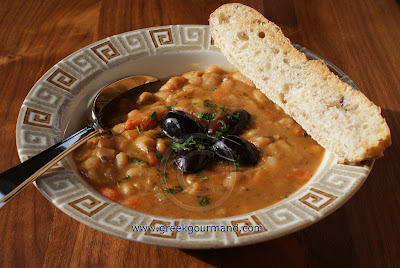
If people really are what they eat, then I am convinced that Greeks (and many Italians) are in no small part composed of various pulses. Growing up in a Greek household means that you have either learned to enjoy or to dread that next meal consisting of beans, lentils, and/or chickpeas; whether they are dried, fresh, roasted, baked, or boiled, believe me, we have had our fill. True Greek soul food . Click to Enlarge Image. Since the remotest antiquity, pulses have been a fundamental staple of Greek food culture. Indeed, beans were such a familiar item to Homer that he used a bouncing bean simile to describe the manner in which an arrow deflected from the armour of King Menelaus in a mortal encounter (Iliad, Book XIII, 589). And depending on whom you believe, Pythagoras either admonished against, or eagerly encouraged his fellows in the consumption of beans. Best thing about beans? They’re cheap! Next best thing about beans? They are good for you. Third best thing ...

Village Greek Salad (Χωριάτικη Ντοματοσαλάτα)

Image
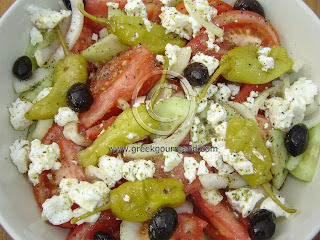
Village Greek salad in all its glory - Click to Enlarge Image Exactly when the tomato arrived in Greece is a matter of conjecture; there are various apocryphal anecdotes and references but nothing definitive. One thing is certain; it arrived sometime after Columbus returned from the New World in 1493. The tomato is native to the Americas and was introduced to Europe after the Discovery made by the great 15 th Century navigator on his celebrated voyage across the Atlantic . If Christopher Columbus was of Greek origin as some claim, it may have arrived in Greece earlier than commonly supposed. In any case, the tomato qua tomato has been a part of European and Greek recipes for no more than a few centuries all told. It is downright astonishing how this species of nightshade spread and insinuated itself into the national cuisines of the European continent in such a relatively short time. After all, where would Italian cooking be without the tomato? How about the Spanish food fig...

Fassolakia Moraïtika – Peloponnesian Braised Green Beans (Φασολάκια Μοραΐτικα)

Image
A rustic Greek vegetarian dish from the Peloponnesus There was once a City Mouse who went to visit his cousin in the Country. The Country Mouse was a simple fellow but he loved his relative from the Big City and did his best to make him feel at home; all he could offer him were some beans and bread crumbs, and he generously spread these before him. The City Mouse snickered at the poor country food, and said: "Cousin, I cannot understand how you are satisfied with such simple food as this… Of course one really should not expect too much seeing as you live way out here in the Country, but why don’t you come back with me to the city for a while and let me show you how to really eat? A week in town with me and you will wonder how you could ever have been content with country living." And so, the two mice set off for the Big City and arrived at the City Mouse's residence late in the evening. "You look like you could use some refreshments after our trip," the Cit...

Grilled Eggplant Salad (Σαλάτα Ψητή Μελιτζάνα)

Image
An excellent seasonal eggplant salad - Click to Enlarge Image This posting is all about appreciation. Appreciation for the people who visit this Greek food blog and take the time to comment when they see something they like; appreciation for those who share this blog with their friends, and those who share its contents with the world by Digging , Stumbling , or otherwise adding it to their social networks; appreciation for the many friendships I have made with other bloggers who post about their lives and passions, whether these be Greek food related or not. It continues to be my great pleasure to share my thoughts and Greek recipe selections and reflections with all of you. I am deeply moved and inspired by the encouragement and support you have shown to a perfect stranger who rambles on about Greek cooking and history and the like. Truly, your example typifies the concept of xenia (Greek notion of a guest-host relationship) and I graciously thank each and every one of you for...

Village Zucchini Fritters (Χωριάτικοι Κολοκυθοκεφτέδες)

Image
My mother-in-law's Greek village recipe - Click to Enlarge Image This timely seasonal Greek recipe incorporating zucchini has many permutations throughout various regions of Greece . This particular version is my mother-in-law’s “village” recipe and makes for an excellent Greek vegetarian appetizer dish. You can serve these fritters with some tzatziki (Greek yogurt garlic sauce) or eat them on their own; either way, they make for some addictive eating; so go easy, it is fried… I used fresh-picked zucchini and mint from our kitchen garden to make this dish. Also, I usually make this recipe using a mixture of peanut oil and Greek olive oil in the frying for the reason outlined in my Feta Fries recipe. Contrary to popular opinion, olive oil is excellent for frying and is used liberally for that purpose throughout Greek cuisine. Its high smoke point (210º C/ 410 º F) is well above the ideal temperature for frying food (180º C/350 ºF), and it retains many of its healthful properti...

Amaranth with Scorthalia (Βλήτα με Σκορδαλιά)

Image
Amaranth with Scorthalia - Click to Enlarge Image A Rose and an Amaranth blossomed side by side in a garden, and the Amaranth said to her neighbour, "How I envy you your beauty and your sweet scent! No wonder you are such a universal favourite." But the Rose replied with a shade of sadness in her voice, "Ah, my dear friend, I bloom but for a time: my petals soon wither and fall, and then I die. But your flowers never fade, even if they are cut; for they are everlasting." - Aesop , The Rose and Amaranth Looking to add some more leafy greens to your diet? Greeks generally consume more leafy greens, vegetables, and fruits than all other Europeans. Wild greens in particular are quite popular throughout Greece and this has led to the semi-domestication of certain species. One of my family’s favourites is Amaranth, or more colloquially known as “ vlita ” in Greece [Gr. βλήτα pronounced ‘VLEE-tah’]. The name Amaranth comes from the Greek amaranthos (αμάρανθος) the ...

Patates Lemonates… Lemon Potatoes

Image
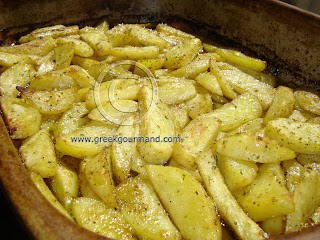
Greek Lemon Potatoes fresh out of the oven… I thought I might share my all-time favourite recipe for perfect Lemon Potatoes. This dish is simple to make and simply delicious! You can serve it as an accompaniment to a wide variety of meat or vegetable mains, or you can eat it on its own with a salad and a generous piece of real Greek feta cheese. And if you have some fresh crusty white bread handy you can use it to wipe up the excess lemon oil straight from the pan… As for the potatoes, I use (and recommend you use) the Yukon Gold variety as their yellow flesh bakes in and absorbs the lemon juice and olive oil wonderfully well, and yet they retain a nice cruchiness around the edges. When I'm in Greece, I only use Arcadian potatoes. The oregano has to be Greek, and only the highest quality Greek extra virgin olive oil will do. Now, follow my directions to the letter and you will enjoy a pan of perfect lemon potatoes! Recipe: 2.5 lbs. (1 kg.) potatoes washed and peeled. Juice from 2 ...

Gigantes Tiganiti … Pan-Fried Giant Beans

Image
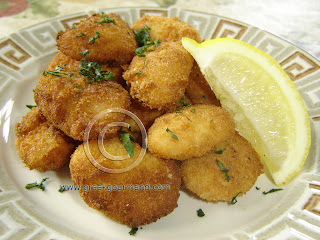
Gigantes Tiganiti … Pan-Fried Giant Beans make an excellent appetizer dish. Since time immemorial beans and legumes have figured prominently in regional dishes throughout Greece. Dried Gigantes beans (pronounced YEE-GAN-DES) are a staple of Greek cookery and can usually be found in Greek specialty shops and bakeries, or most well-stocked supermarkets around the world. Also referred to as Elephant beans, Gigantes are about 1 inch long or roughly twice the size of conventional lima beans, and are a variety of runner bean . Cultivated largely in north central Greece, these beans can be prepared and served as an appetizer, as part of a salad, or as a main course. Indeed, this bean is so popular in Greece that five varieties of Gigantes/Elephant beans have been recognized as Protected Designation of Origin ( PDO ) / Protected Geographical Indication ( PGI ) produce by the European Union. The extraordinarily meaty and buttery texture of this extra large bean has served to make them a ub...

Gemista… Stuffed Peppers and Zucchini (Vegetarian)

Image
Stuffed Peppers and Zucchini just like grandma used to make... This is one of the quintessential Greek dishes and can either be cooked as a vegetarian meal or made with the addition of ground beef. This version is vegetarian and Lenten friendly for those of you who may be avoiding meat or fasting. This particular recipe was my grandmother’s and she used to make it in a wood-burning oven which made all the difference in flavour. Variations on this dish include stuffing tomatoes and other vegetables; however, this specific recipe works best with peppers and zucchini. Years ago, here in Canada, before Greek food became synonymous with fast food fixes like Souvlaki and Gyros, all of the Greek restaurants on Danforth Avenue (Toronto’s Greek town) served stuffed vegetables along with other “ magirefta ” or ‘ready-cooked’ meals. Of course, this was back in the 60’s and 70’s when Greek eateries catered largely to a Greek immigrant clientele who were familiar with such dishes. Back then, w...

Fava

Image
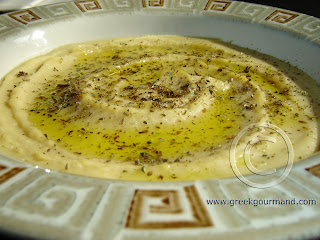
Fava with a drizzle of olive oil and a sprinkle of lemon & dried oregano Each year with the approach of Lent, Greeks all over the world prepare for the Easter celebration by fasting for a forty day period. The greater part of this fast consists in abstaining from meats and animal by-products including dairy foodstuffs like eggs, milk and butter. Coincidentally, this fasting period (called Sarakosti or 'forty days') arrives at just the right time to help us shed some of the extra weight we have put on during the winter months! Of course, it is always a challenge to come up with appropriate foods that are both tasty and varied, but thanks to the wide range of Greek gastronomic specialties this period can be anything but monotonous. Fava is essentially a yellow split-pea purée and it is especially popular on the Greek islands, particularly Santorini (or Thera) and Crete. On Santorini, fava is an important element in that island’s cookery, and it is eaten year round as a...