Posts

Showing posts with the label feta cheese

Grilled Banana Pepper Salad (Πιπεριές Ψητές με Φέτα)
Image
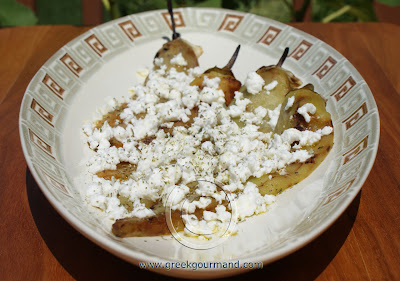
The summer grilling season ensures a steady supply of grilled vegetables on our table. One of my father's favourite salads during this period is also one of the most notorious in our family. Grilled hot banana peppers - Click to Enlarge I'll never forget the day I first sampled this recipe. You have probably walked by them a thousand times in the vegetable section wherever you shop, and yet, you may never even have given them so much as a second glance. Here is what I often think about whenever I see hot banana peppers in a market: My father proffered a plate and slid a cousin of one the beauties from the photo above on to my dish. He instructed me to roll it up, slip it into a wedge of folded pita, and take a large bite. My mother, meanwhile, warned me not to listen to my father, that the pepper was too hot. But, I was a child, and a wilful one at that, so my mother's warning served as nothing more than the equivalent of a challenge. I did as my father instructed, th...
Greek Food Feature: Feta Cheese (Φέτα)

Image
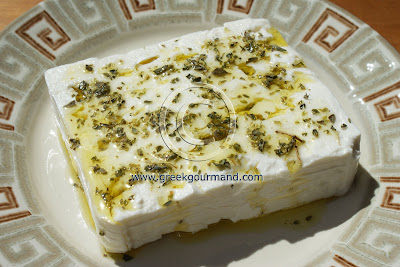
This is the first posting in a new series of spotlight articles on Greek food products and ingredients which I will be presenting on this blog. A slab of Feta served up in classic Greek fashion - Click to Enlarge My grandmother used to make her own cheeses. When I was a child, I used to love watching the woman set herself on a small wooden stool for the milking of the sheep and goats. She would call for me to bring the collection pails and I would run to fetch them. As she milked the swollen teats of the ewes and does, I would offer to help, but she always refused saying that the animals required practised, familiar hands. So, I had to content myself with helping her by swapping the buckets when she instructed. She always made sure to leave some milk for the sucklings; and there was always a cup of warm milk set aside for me, before she thickened the rest and drained off the whey from the curds for cheese-making. Although she used rudimentary equipment i.e., wicker baskets, mus...

Village Greek Salad (Χωριάτικη Ντοματοσαλάτα)

Image
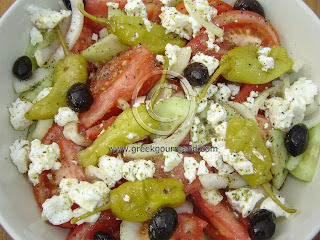
Village Greek salad in all its glory - Click to Enlarge Image Exactly when the tomato arrived in Greece is a matter of conjecture; there are various apocryphal anecdotes and references but nothing definitive. One thing is certain; it arrived sometime after Columbus returned from the New World in 1493. The tomato is native to the Americas and was introduced to Europe after the Discovery made by the great 15 th Century navigator on his celebrated voyage across the Atlantic . If Christopher Columbus was of Greek origin as some claim, it may have arrived in Greece earlier than commonly supposed. In any case, the tomato qua tomato has been a part of European and Greek recipes for no more than a few centuries all told. It is downright astonishing how this species of nightshade spread and insinuated itself into the national cuisines of the European continent in such a relatively short time. After all, where would Italian cooking be without the tomato? How about the Spanish food fig...

Feta Fries

Image
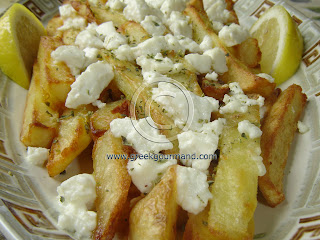
Try my Feta Fries for a fast Greek food fix! Click to Enlarge Image Here in Canada , we have rather limited choices when it comes to Canadian cuisine per se. Instead, Canadians are quite well exposed to the whole gamut of ethnic foods that arrived -and continue to arrive- with the polyglot immigrant populations who call Canada “ Home ” (which is everybody but the Native Peoples). In fact, about the only Canadian dish I can think of is Poutine and that is originally from Quebec, the Francophone part of the country. To be honest, I was never very fond of Poutine. Perhaps it is the gravy, or the tasteless cheese curds, or the sloppiness of the dish which turned me off, I really do not know what it is, but I have never liked it very much. However, as I was helping my sister and brother-in-law to move the other day, I found myself out in rural Ontario and needing a quick fix for my road hunger. Sure enough, a sign advertising “Fresh Cut Fries – Poutine” appeared by the side of...

Feta Fritters (Φέτα Τηγανίτες)

Image
Feta fritters best served hot! - Click to Enlarge Image This coming Wednesday, I will be doing a Greek cooking demonstration entitled “Things to Do with Feta Cheese” to an audience of some 20 people or so; this is one of the recipes that I will be presenting. Credit for the recipe goes to my Aunt Dimitra, who has been making these tasty little bites for as long as anyone in my family can remember. She has graciously allowed me to add this dainty to my repertoire of Greek food recipes and thereby make it my own. This little morsel is especially popular with the kiddies, and makes for a great appetizer or snack with some cold Retsina wine and a few Kalamata olives. The key to this recipe is to chill the fritter mix well before cooking to ensure cohesion throughout the frying. Ingredients: 1 cup (250 ml.) good quality crumbled Greek feta cheese 2 lbs (1 kg.) potatoes 2 eggs, well-beaten 1 medium sized onion, finely diced ½ cup (125 ml.) dried bread crumbs ½ cup (125 ml.) Greek extra virgi...

Patatopita... Potato Pie

Image
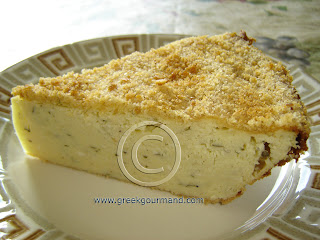
There's nothing like some Big Fat Greek Potato Pie! One of the most distinguished and yet least well-known figures of Modern Greek and European History is the Corfiote (i.e. from the island of Corfu), Ioannis Kapodistrias . He was born in the year of American Independence, 1776, when Corfu and the rest of the Ionian Islands were still under Venetian dominance. As one of his ancestors had received title from Charles Emmanuel II, Duke of Savoy , Kapodistrias was a hereditary Count whose family name was entered in the Libro d'Oro of Corfu in 1679. At age 21, he left home to study philosophy, law, and medicine at the University of Padua in Italy; from there he went on to establish himself as one of the foremost figures in European diplomatic history of the early 19th century. Count Kapodistrias was the arch nemesis of the legendary Austrian “Fox” Prince Metternich , and he was directly responsible for the diplomatic recognition of a neutral and independent Switzerland (even...