Posts

Showing posts with the label Crete

Kalitsounia (καλιτσούνια)

Image
My love affair with Kalitsounia started when Mr K and I visited Crete a few years ago. Kalitsounia (καλιτσούνια) are small pies, either filled with sheep cheese and drizzled with honey for a sweet dessert, or filled with cheese, herbs and/or greens and onion for a savoury snack. These little pies are unique to Crete and the island has become famous for them. Kalitsounia are traditionally served at Easter time and filled with two cheeses unique to Crete, along with some mint. There are also two popular kalitsounia shapes for Easter, a square and a 'little lantern'. Beyond Easter, kalitsounia are often served at big family gatherings and parties. They can also either be baked or fried. If you are visiting Crete, kalitsounia can be found in baker's shops and tavernas all year round. In Chania, some of the best Kalitsounia can be found at the Central Market. The Municipal Market of Chania is in the heart of the city and dates back to 1913. The market is full of fresh local pr...

Cretan Dakos, or Koukouvayia (Owl) - Ντάκος

Image
I have returned from my Blog Interruptus with a tale of autumn adventures on the island of Crete, along with a recipe for all those tomatoes in the pantry. Enjoy! Cretan Dakos - Click to Enlarge Image In my travels about Greece, I have been to Crete twice. The first time I touched foot on the legendary isle of King Minos, I spent a day there as one leg of an Aegean culture cruise; we visited Knossos and the Herakleion Museum. I was so inspired by my visit to the former that I was left with a burning desire to return someday and see more of that famous isle. As I sailed away that first time from the Cretan shoreline, I half-expected Talos to appear along the coast to see me off... Years later, I landed on Cretan soil again. This time, I spent a couple months exploring the island by foot, motorbike, and boat. It would not be an exaggeration to say that my sojourn there had the character of a sacred pilgrimage, or perhaps it was something akin to an initiatory walkabout or rite of...

Spiral as in Baklava

Image
My Cretan spiral baklava ready for action - Click to Enlarge The origin of baklava , a pastry composed of layers of phyllo containing nuts and soaked in honey syrup, is something of a bone of contention among certain types who have nothing better to do with their time. I have heard Turks, Lebanese, and others claim it as their own. Whoever may have invented the dish, whether Greek, Levantine, Turk or whatever, it is not made in the same way by all; the variations include the types of nuts used, the ratios of nuts to phyllo, the shapes of the dessert, and the spices and flavourings that go into the pastry itself or into its syrup. Frankly, I am not overly concerned as to whether the Byzantine Greeks, the Arabs, or the Ottomans, or even the Chinese (!) created this dessert; I know it simply as a part of traditional Greek cookery, and as far as I am concerned, baklava is Greek. This particular recipe is from Crete , from a family that I had met while backpacking on the island back ...

Fava

Image
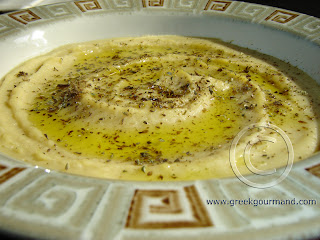
Fava with a drizzle of olive oil and a sprinkle of lemon & dried oregano Each year with the approach of Lent, Greeks all over the world prepare for the Easter celebration by fasting for a forty day period. The greater part of this fast consists in abstaining from meats and animal by-products including dairy foodstuffs like eggs, milk and butter. Coincidentally, this fasting period (called Sarakosti or 'forty days') arrives at just the right time to help us shed some of the extra weight we have put on during the winter months! Of course, it is always a challenge to come up with appropriate foods that are both tasty and varied, but thanks to the wide range of Greek gastronomic specialties this period can be anything but monotonous. Fava is essentially a yellow split-pea purée and it is especially popular on the Greek islands, particularly Santorini (or Thera) and Crete. On Santorini, fava is an important element in that island’s cookery, and it is eaten year round as a...