Posts

Showing posts with the label Dessert

Homemade yogurt and poached quince

Image
     In Greece there are three different types of yogurt, depending on the milk (goat, sheep or cow) used to make it.       Yogurt made from cows’ milk is the most popular because of its mildness; it has a less sour taste compared with yogurt made from the milk of goats or sheep.      In Greece we call yogurt ‘’strained ‘’ if it has undergone a straining process after it has been created. As a result it has far less whey than plain yogurt. Its dense silky texture makes it ideal for cooking too.       If you are lucky enough to have access to fresh milk from local farms, you should definitely try at some point to make yogurt at home and experience its wonderful taste. If you have kids, they will be fascinated by the process that magically turns milk into yogurt.      We make yogurt at home when we have extra milk that is close to its expiry date; this way we give it at least an extra week of shelf life. ...

Greek yogurt macaron, with a honey core

Image
I often wonder what could be characterized as a typical Greek flavor in pastry; and I usually come to the conclusion that yogurt and honey make a pair that many could consider as a classically Greek. So if I make a panna cotta with Greek yogurt and honey, would people think that this Italian dessert has a Greek twist? I can’t judge but it definitely tasted good. Since I have started this ‘alchemy’ of turning famous desserts into Greek with the addition of yogurt and honey, I have discovered that French macarons lend themselves to the treatment! The first time I ever saw macaron was five or six years ago when I started reading food blogs and came across the blog Tartelette . I remember how beautiful they looked in the pictures. Then I tried them in a pastry shop in Athens and was sure I should try making them myself. My research on the internet showed that macarons are more or less the ‘’Holy Grail’’ of every avid food blogger and I decided I needed one more cooking book, this time one ...

Tahini, coffee, and pistachios: vegan cake

Image
In Greece during the Great Lent when dairy products, meat, and eggs are not   consumed (at least for those who still keep these traditions), tahini based recipes enrich their diet with nutritious elements. Tahini, a paste made from ground hulled sesame seeds, is a super food and, added in soups and other vegetable or legume based dishes, it plays a vital role in good nutrition. It contains many vitamins and minerals and is also rich in protein, - 25 percent by weight!   In this blog you may have noticed that several recipes, sweet or savory have the ending pita in their name. That is because we tend to call pita any batter which is baked in a flat baking pan.   So today’s special is Tahinópita , a dairy and egg free cake with tahini as a basic ingredient. Although the original recipe calls for cinnamon and cloves, I decided we had enough cinnamon this winter so a small twist in this cake’s makeup was inevitable: coffee and orange zest in this case. They match really wel...

Apples cooked in vanilla syrup

Image
    An urge to search for traditional recipes with apples resulted because of a walk we took last week near our cottage. We came across a familiar old apple tree still standing next to the ruins of a house. It has never stopped producing apples yearly for more than six decades now as my mother remembers, with no gardener’s care -  just running water from a spring on the property. We hadn’t explored this corner of the village for a couple of years and we were pleased to find that the tree was still productive and that there were still some apples left for us by the birds who had already taken their share. I love that sense of déjà vu under a tree like this, imagining the repeated ritual of harvesting its fruits.  Though apples have been cultivated in Greece for many centuries yet, as far as I know, there are no recipes in Greek traditional cuisine like pies and cakes, which call for apples. They have always been the most popular year round fruit in every house pantry...

Fresh quince and filo, mini pies

Image
     Housewives and chefs have a shared sense of economy in their kitchens. From the shopping list to the fridge leftovers, food is used wisely and nothing gets wasted when it can still be used in cooking.       At our house, the leftovers from the tomato salad we had for lunch would be the base for the tomato sauce in the dinner stew, and the cooked greens I never loved as a kid would turn into a delicious omelet that I would, unsuspiciously, happily eat. But my favorite edition of this cooking trick occurred when my mother would make cheese pies with filo pastry and she would save a couple of sheets to stuff with the last spoonfuls of any jam that had been forgotten in the fridge. The crispiness of the baked filo and the aroma of the hot jam always created a yummy surprise treat because the filling was always different.     You can make a light last minute jam with any seasonal fruits available, and then make sweet filo pies. I made a fres...

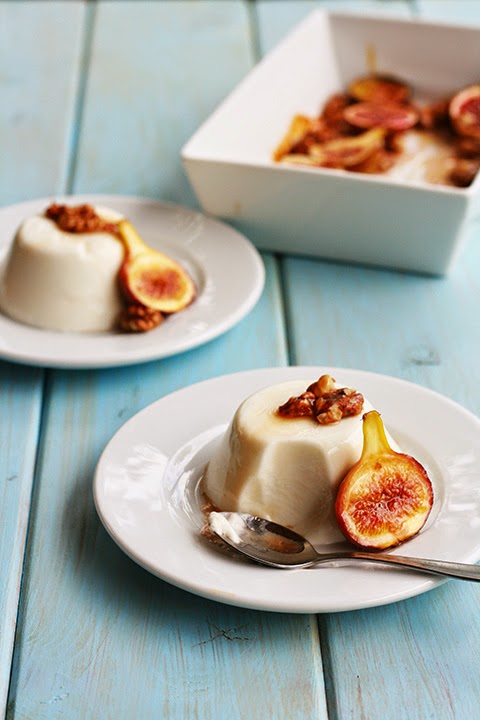
Greek yogurt panna cotta, and baked figs with honey and walnuts

Image
      My grandfather planted a fig tree in the garden of our cottage that, despite its age, has never stopped producing fruits year after year. Fig trees, like olive trees, live long. They are commonly found in the Greek country side next to old houses or ruins, still in perfect shape and full of fruits every August, as if time for them is an endless youth.      I’m sure you have had that ‘feeling’ when visiting an older relative’s house after many years, a sense that you remember it being bigger and suddenly you realize that houses usually keep their shape and that it is you who, like Alice in Wonderland, grew larger. I had that sense the other day with the fig tree in our garden. As a child I used to climb on its branches to pick more figs and back then I used to think it was huge.       Our figs are yellow, the variety used for sun dried figs. Every August my grandmother would lay them on thatch on the terrace under the hot summer sun...

Visináda - Sour cherries refreshing beverage

Image
      Visináda (βυσσινάδα) is one of the favorite beverages in Greece. It is made with the juice of sour cherries and sugar, cooked until it’s concentrated into a thick, deep purple syrup. Though sour cherries are not usually eaten raw, they taste just wonderful when cooked with sugar.  In my little village we have only wild sour cherry trees; I never found out who first cultivated them here but they must have loved this place. And even if you plant only one tree, in a few years you end up with a small wild sour cherry forest because they tend to expand like crazy. Though you need to pit twice the amount of the wild fruit for a recipe compared to cultivated sour cherries, the wild variety has a superb taste. Sour cherries can be found in farmer’s markets at the end of June and early July in Greece; in July and even August in more northern countries. To enjoy visináda, pour in a glass, one part of syrup and four parts of ice cold water or club soda and fill with ...

Koulourákia - Easter cookies

Image
      Whereas Christmas is celebrated in Greece in much the same way as it is globally (Christmas trees,presents, blinking lights, stuffed turkey), Easter is, for us, a unique feast  of special foods, traditions ,and most of all, huge, noisy, and long anticipated family gatherings.  Sweet breads flavored with mastic ( tsourekia ) and Easter cookies, (koulourákia) are the most popular treats every housewife makes annually for the family and to give away to friends. Of course everyone has this or her own recipe for those special treats. Well, almost everyone did, because in my home town we all shared the same ‘’secret” recipe. It was very common in small towns during the 80’s and 90’s, before the big super markets arrived, to buy all food supplies from the local grocer. So, during  the week leading up to Easter, we would simply ask for the ingredients needed to make 3-4 kilos of Easter cookies.  Home produced eggs and milk were used if available but the...

Baklava with walnuts, almonds and olive oil

Image
Baklava has a Middle Eastern origin but it has been incorporated into Greek cuisine to such a degree that many people nowadays believe it’s actually a Greek dessert. That’s fair enough because in Greece we love every dessert made with phyllo pastry and syrup no matter what the filling might be. These desserts are categorized as ‘’siropiastá’’ (σιροπιαστά) which means ‘’syrup soaked’’ desserts.  Of course, every home cook has his or her own version of baklava: with walnuts and almonds or pistachios, with or without spices, and finally with either butter or olive oil. I have to admit that butter gives a wonderful taste to baklava but my grandmother disagreed. She preferred making her baklava with olive oil during the Lenten season before Easter. She believed it was the tastiest vegan dessert and, in any case, she wanted to use up the remaining walnuts from the previous year’s crop before hot weather would turn them tangy.  Olive oil doesn’t affect baklava’s taste because the f...

Amygdalotá - almond meal, gluten free cookies

Image
      Almond based confections or amygdalotá (αμυγδαλωτά) as we call them are found all over Greece in endless versions. They can be shaped like pears, balls, or little logs and are usually flavored with scented flower blossom water,  a liquor or, less often, with vanilla.  They are often sold filled with jam or chocolate ganache  and resemble French macarons. Amygdalotá in many Aegean islands are a special little treat symbolizing happiness and prosperity  and offered to guests  at weddings and Christenings,.  The version of amygdalotá I made today is found in pastry shops all over the country. They are plainer than the filled versions and made with a higher ratio of almond meal. Amygdalotá Makes 18 big or 36 bite-sized, cookies 250gr blanched almonds 150gr confectioner’s  sugar 2 egg whites (70gr) Vanilla flavoring a pinch of salt 18 almonds for decoration   In a food processor fitted with the steel blade grind the almonds ...