Posts

Showing posts with the label appetizer

Feta Fritters (Φέτα Τηγανίτες)

Image
Feta fritters best served hot! - Click to Enlarge Image This coming Wednesday, I will be doing a Greek cooking demonstration entitled “Things to Do with Feta Cheese” to an audience of some 20 people or so; this is one of the recipes that I will be presenting. Credit for the recipe goes to my Aunt Dimitra, who has been making these tasty little bites for as long as anyone in my family can remember. She has graciously allowed me to add this dainty to my repertoire of Greek food recipes and thereby make it my own. This little morsel is especially popular with the kiddies, and makes for a great appetizer or snack with some cold Retsina wine and a few Kalamata olives. The key to this recipe is to chill the fritter mix well before cooking to ensure cohesion throughout the frying. Ingredients: 1 cup (250 ml.) good quality crumbled Greek feta cheese 2 lbs (1 kg.) potatoes 2 eggs, well-beaten 1 medium sized onion, finely diced ½ cup (125 ml.) dried bread crumbs ½ cup (125 ml.) Greek extra virgi...
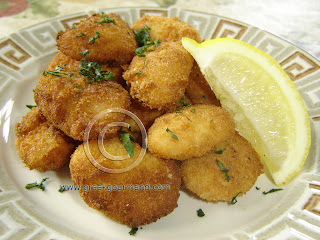
Gigantes Tiganiti … Pan-Fried Giant Beans

Image
Gigantes Tiganiti … Pan-Fried Giant Beans make an excellent appetizer dish. Since time immemorial beans and legumes have figured prominently in regional dishes throughout Greece. Dried Gigantes beans (pronounced YEE-GAN-DES) are a staple of Greek cookery and can usually be found in Greek specialty shops and bakeries, or most well-stocked supermarkets around the world. Also referred to as Elephant beans, Gigantes are about 1 inch long or roughly twice the size of conventional lima beans, and are a variety of runner bean . Cultivated largely in north central Greece, these beans can be prepared and served as an appetizer, as part of a salad, or as a main course. Indeed, this bean is so popular in Greece that five varieties of Gigantes/Elephant beans have been recognized as Protected Designation of Origin ( PDO ) / Protected Geographical Indication ( PGI ) produce by the European Union. The extraordinarily meaty and buttery texture of this extra large bean has served to make them a ub...

Taramosalata (or Tarama)... Fish Roe Salad is Good For You!

Image
Taramosalata (or Tarama) garnished with an olive. Fish roe is a superb source of vitamins A and D, zinc, and long-chain fatty acids. As deficiencies in one or all of these nutrients can cause birth defects during pregnancy, I highly recommend this recipe for pregnant women in particular. This is not to say that the rest of us cannot benefit from the inherent richness of this dish, so let us follow the dictum of Hippocrates and “make our food our medicine”. Carp roe (also called ‘ Tarama ’), is the variety most commonly used today for taramosalata and there are two types: one is distinctively dyed a salmon-red colour and the other is the undyed natural beige coloured roe. When I was very young, I thought this dip was like a pudding and I simply could not get enough of it, I did not bother to eat it with pita or any other kind of bread; I preferred it on its own. However, it appears my palate has mellowed with age and I have grown to appreciate some warm Greek-style pita bread as an acc...