Posts

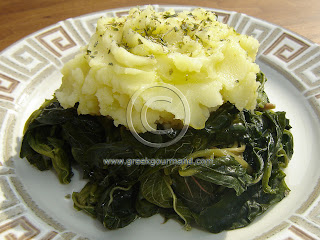
Amaranth with Scorthalia (Βλήτα με Σκορδαλιά)
Image
Amaranth with Scorthalia - Click to Enlarge Image A Rose and an Amaranth blossomed side by side in a garden, and the Amaranth said to her neighbour, "How I envy you your beauty and your sweet scent! No wonder you are such a universal favourite." But the Rose replied with a shade of sadness in her voice, "Ah, my dear friend, I bloom but for a time: my petals soon wither and fall, and then I die. But your flowers never fade, even if they are cut; for they are everlasting." - Aesop , The Rose and Amaranth Looking to add some more leafy greens to your diet? Greeks generally consume more leafy greens, vegetables, and fruits than all other Europeans. Wild greens in particular are quite popular throughout Greece and this has led to the semi-domestication of certain species. One of my family’s favourites is Amaranth, or more colloquially known as “ vlita ” in Greece [Gr. βλήτα pronounced ‘VLEE-tah’]. The name Amaranth comes from the Greek amaranthos (αμάρανθος) the ...
Feta Fries

Image
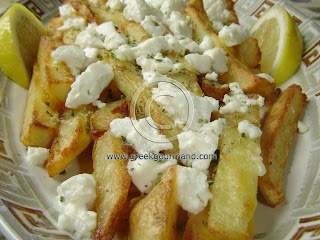
Try my Feta Fries for a fast Greek food fix! Click to Enlarge Image Here in Canada , we have rather limited choices when it comes to Canadian cuisine per se. Instead, Canadians are quite well exposed to the whole gamut of ethnic foods that arrived -and continue to arrive- with the polyglot immigrant populations who call Canada “ Home ” (which is everybody but the Native Peoples). In fact, about the only Canadian dish I can think of is Poutine and that is originally from Quebec, the Francophone part of the country. To be honest, I was never very fond of Poutine. Perhaps it is the gravy, or the tasteless cheese curds, or the sloppiness of the dish which turned me off, I really do not know what it is, but I have never liked it very much. However, as I was helping my sister and brother-in-law to move the other day, I found myself out in rural Ontario and needing a quick fix for my road hunger. Sure enough, a sign advertising “Fresh Cut Fries – Poutine” appeared by the side of...

The Apple in My Pie (Milopita - Μηλόπιτα)

Image
My Milopita fresh from the oven - Click Image to Enlarge Apples are among the earliest fruits known to Europeans. The ancient Greeks have left us numerous references to the apple both in literary and philosophical sources. According to a couple of accounts, it was the god Dionysus who first introduced the apple to mortals. The apples from a town called Sidus, near the ancient city of Corinth were among the most prized of antiquity. Today, Greek apple farming takes place largely in central and northern Greece, especially around the village of Zagora on the slopes of Mt. Pelion, and in the vicinity of the city of Kastoria in Macedonia. Some apple farming also takes place near Tripolis, a city in the central part of the Peloponnese. The apples of all three areas are registered as Protected Designation of Origin (PDO) / Protected Geographical Indication (PGI) products of Greece by the European Union. “Apples Kastoria” (Μήλο Καστοριάς) are especially prized for their flavour. Greece produ...

Feta Fritters (Φέτα Τηγανίτες)

Image
Feta fritters best served hot! - Click to Enlarge Image This coming Wednesday, I will be doing a Greek cooking demonstration entitled “Things to Do with Feta Cheese” to an audience of some 20 people or so; this is one of the recipes that I will be presenting. Credit for the recipe goes to my Aunt Dimitra, who has been making these tasty little bites for as long as anyone in my family can remember. She has graciously allowed me to add this dainty to my repertoire of Greek food recipes and thereby make it my own. This little morsel is especially popular with the kiddies, and makes for a great appetizer or snack with some cold Retsina wine and a few Kalamata olives. The key to this recipe is to chill the fritter mix well before cooking to ensure cohesion throughout the frying. Ingredients: 1 cup (250 ml.) good quality crumbled Greek feta cheese 2 lbs (1 kg.) potatoes 2 eggs, well-beaten 1 medium sized onion, finely diced ½ cup (125 ml.) dried bread crumbs ½ cup (125 ml.) Greek extra virgi...

Epirote Makaronopita (Μακαρονόπιτα Ηπειρώτικη)

Image
Epirus, Land of Mystery and Makaronopita - Click to Enlarge Image Last summer, my wife and I decided to explore Northern Greece. So, we rented a car in Athens and added 3600 kilometres to its odometer in the course of our excursion. Traveling from Thessaloniki , we entered the region of Epirus by highway from the east, over and through the Pindus mountain range which forms the rooftop and backbone of the northwestern end of the Greek mainland. This corner of Greece remains a wild country; isolated, mountainous, heavily forested and sparsely populated. There is still a hint of primeval mystery that permeates the fresh clean air of Epirus, something like the coolness of an evening shade borne upon the winds throughout the region. If there are still undiscovered curiosities in Greece, rest assured, they lie hidden among the ethereal morning hazes and the deep wooded ravines of Epirus. As far back as the archaic days of its semi-barbaric status as a hinterland of the Ancient Greek worl...

A Kumquat Sweet for Your Thoughts (Κούμκουατ Γλυκό)

Image
A Kumquat Sweet for Your Thoughts – Click to Enlarge I was first introduced to this exotic Greek confection in the late ‘90s. One of my friends had gone to Greece for the summer and had returned with several packages of individually wrapped kumquat sweets , an exclusive specialty of the Ionian island of Corfu (Kerkyra). Though I was already familiar with Corfiote (i.e. of Corfu ) kumquat liqueur, I had never tried the glacé fruit until my friend, Kyriakos, generously shared some of his supply with me. Needless to say, I was immediately hooked. The subtle orange citrus bitterness of the fruit’s tender though slightly chewy translucent flesh was totally suffused with the sweetness of its sugar syrup and was simply irresistible. Interestingly enough, not long after that first sampling, I remember learning that upon completion of the filming on location in Greece for the James Bond movie “ For Your Eyes Only ” (1981), Roger Moore left Greece with several suitcases stuffed fu...

Mad About Aubergine (Eggplant) Rolls... Μελιτζάνες Τυλιχτές

Image
Melitzanes Tylichtes (Eggplant Rolls) - Click to Enlarge Image Greeks are simply crazy over eggplant or melitzana ( μελιτζάνα ) in Greek, pronounced “meh-lee-TZAH-nah”. We puree, braise, boil, stew, stuff, bake, fry, grill, roast, and preserve them as sweets; a culinary obsession which may lend some credence to the original European prejudice against the fruit which was dubbed "mala insane" (Latin for “apple of madness”), as it was believed to cause insanity. Both the Italian ( melanzano ) and Greek ( melitzana ) words for “eggplant” are derived from this medieval nickname. The French term for eggplant "aubergine" is derived from Arabic. As the eggplant, like the tomato and potato to which it is related in genus is not native to Europe (witness the lack of any Roman or ancient Greek word for it), its introduction from the East sometime in the Middle Ages was initially greeted with suspicion and only gradually was it embraced, cultivated, and consumed with any gu...