Posts

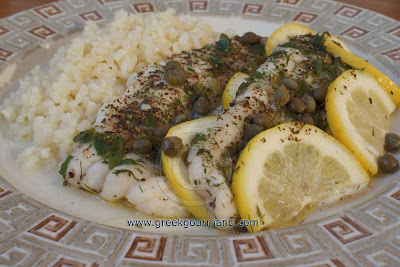
Baked Sole (Γλώσσα στο Φούρνο)
Image
Looking for a healthy meal that is quick and easy to prepare? Something that will have you in and out of the kitchen in 30 minutes flat? Look no further, this recipe will have you sitting down to an enjoyable dinner before you can learn to say νιψονανομηματαμημονανοψιν ! Minimal prep time, basic ingredients, and very little supervision are required for this dish from the Aegean islands. A sampling of Aegean flavours - Click to Enlarge Image I first ran across variations of this dish on the island of Santorini, where I was working in the mid '90s. Being the adventurous sort, I spent a couple years getting the "Summer Lovers" thing out of my system by escaping to the Greek isles and experiencing all that they have to offer. Let me just say that the reality was everything I had imagined it to be and more. If you have ever considered just chucking everything and going to ground somewhere in the Aegean for an entire summer, I urge you to do it without a second tho...
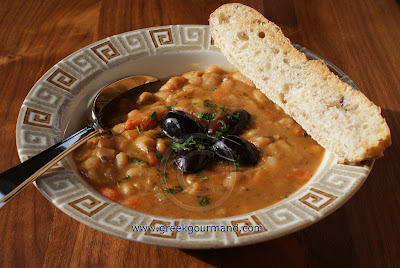
Fasolada (Φασολάδα)

Image
If people really are what they eat, then I am convinced that Greeks (and many Italians) are in no small part composed of various pulses. Growing up in a Greek household means that you have either learned to enjoy or to dread that next meal consisting of beans, lentils, and/or chickpeas; whether they are dried, fresh, roasted, baked, or boiled, believe me, we have had our fill. True Greek soul food . Click to Enlarge Image. Since the remotest antiquity, pulses have been a fundamental staple of Greek food culture. Indeed, beans were such a familiar item to Homer that he used a bouncing bean simile to describe the manner in which an arrow deflected from the armour of King Menelaus in a mortal encounter (Iliad, Book XIII, 589). And depending on whom you believe, Pythagoras either admonished against, or eagerly encouraged his fellows in the consumption of beans. Best thing about beans? They’re cheap! Next best thing about beans? They are good for you. Third best thing ...

Tastes of Cyprus – An Interview and a Recipe

Image
According to Greek Mythology, the island of Cyprus takes its name from the goddess Aphrodite, which makes the island her own special abode. I have never been to Cyprus, though I have heard of its natural beauty, and I do have a number of Cypriot friends. Toronto has a sizable Cypriot community, and over the years, I have had a chance to learn something about their ways and means. I have also had a chance to sample some of their foods. A table filled with Cypriot and Greek food specialties There are many similarities between the foods of Greece and Cyprus, but there are notable differences too. At the invitation of the Consul General of the Republic of Cyprus, Mr. Stavros Avgoustides, I had a chance to sample some specialties of that island nation. Last week, I had the pleasure of attending the annual cutting of the Vasilopita at the Cypriot Consulate in Toronto. It was a small, intimate affair which included family members of the consulate staff, the consul general and staff from...

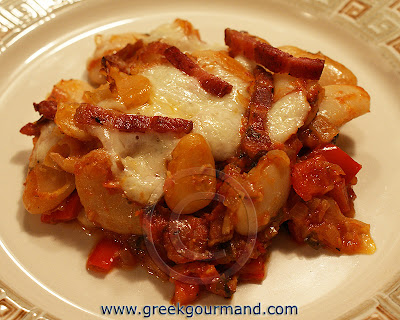
Gigantes Beans with Bacon & Cretan Graviera Cheese (Γίγαντες με Μπέικον και Γραβιέρα)

Image
 It was a day filled with family, great Greek food, fun, and custom; we look forward to many more days filled with the same. A serving of my Gigantes with bacon and Cretan Graviera cheese - Click to enlarge image In the spirit of ushering in a New Year with something novel, I offer my own spin on one of the classic dishes of Greek cookery: a baked bean dish that we call “ Gigantes ” (pronounced ‘YEE-ghan-dess’) after the name of the extra large runner beans that are its main ingredient. Five varieties of Gigantes beans have been registered as PDO/ PGI produce within the European Union by the Greek government. Gigantes beans are cultivated primarily in the area of Lake Prespa, in the north-western part of the Greek region of Macedonia, but they are universally enjoyed throughout Greece. Dried Gigantes beans - Click to enlarge image Many of the local dishes in the northern Florina prefecture include variations on a red pepper theme. In particular, the spicy red “Florina ...

Kourabiedes (Κουραμπιέδες)

Image
 It will only take a moment of your time, it will not cost you anything, and you will be helping to ensure somebody somewhere gets a meal they desperately need. Thank you for your kind consideration. Now, on to the fun stuff- a sweet Greek recipe! One of the quintessential Greek holiday cookies is immediately recognizable by its confectionery sugar- dusted coat. Though they may be made in a variety of shapes, Kourabiedes (pronounced “koo-rah-bee-YEH-thess”) are most often fashioned into an S shape or lady finger style biscuit. My own preference is for a round bite-sized type of cookie, and that is how I make them. Kourabiedes are butter cookies traditionally baked for Christmas and Easter festivities, but they keep well when stored, so you can enjoy them with a morning Greek coffee long after both holidays have passed. In some regions of Greece, the Christmas Kourabiedes are adorned with a single whole spice clove embedded in each biscuit. This is done to commemorate the spi...

Cretan Dakos, or Koukouvayia (Owl) - Ντάκος

Image
I have returned from my Blog Interruptus with a tale of autumn adventures on the island of Crete, along with a recipe for all those tomatoes in the pantry. Enjoy! Cretan Dakos - Click to Enlarge Image In my travels about Greece, I have been to Crete twice. The first time I touched foot on the legendary isle of King Minos, I spent a day there as one leg of an Aegean culture cruise; we visited Knossos and the Herakleion Museum. I was so inspired by my visit to the former that I was left with a burning desire to return someday and see more of that famous isle. As I sailed away that first time from the Cretan shoreline, I half-expected Talos to appear along the coast to see me off... Years later, I landed on Cretan soil again. This time, I spent a couple months exploring the island by foot, motorbike, and boat. It would not be an exaggeration to say that my sojourn there had the character of a sacred pilgrimage, or perhaps it was something akin to an initiatory walkabout or rite of...

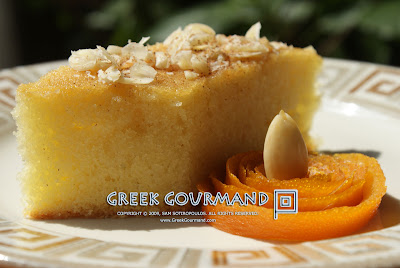
Revani (Ρεβανί)

Image
According to the Greek Orthodox Christian calendar, today is the Metamorphosis (Transfiguration) of the Saviour. The Greek word for "saviour" or "deliverer" is Soter ( Σωτήρ ), and my Greek name is Sotiris; which makes this my Name Day. In point of fact, my name is an epithet which pre-dates Christianity among the Greeks. The term, Soter, has been used as an epithet for Olympian gods, ancient heroes and liberators, and most recently, as a title for Jesus of Nazareth. A thing of beauty! - Click to Enlarge Image For Greeks, Name Days are more important than birthdays. Indeed, it is on one's Name Day that a party in honour of the individual is held, usually at the celebrator's home. Name Days are a time for family and friends, and the day is filled with visits and phone calls from well-wishers. The traditional greeting for someone who is celebrating a Name Day is "Chronia Polla" (Χρόνια Πολλά), which translates as "Many Years"; similar ...